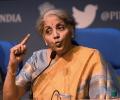
Finance Minister Nirmala Sitharaman presented her third Budget on February 1.

'India will jump 30-40 places in the World Bank ranking of ease of doing business next year.'

'A key reason for the strong interest in IPOs has been an increased focus on profitability and reasonable pricing of deals.'
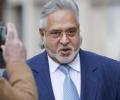
Embattled liquor baron Vijay Mallya, who lost his UK high court appeal against an extradition order to India, has said that he is "disappointed" with the ruling but will continue to seek legal remedies as advised by his legal team. The 64-year-old former Kingfisher Airlines boss reiterated that he has repeatedly offered to pay the Indian banks the loan amount owed by his now-defunct airline, an offer which the banks have rejected.

India is set to witness a roller-coaster growth in the next three years ranging between 6-7 per cent mainly due to fluctuations in prospects of industry and services sectors, according to the Asian Development Bank.

'MFs have a combined exposure of Rs 3.2 lakh crore to NBFCs, out of which Rs 1.1 lakh crore matures by September 2019.'

Prime Minister Narendra Modi laid the foundation stone laying ceremony of the Manipur water supply project via video link.

India's exports may have touched an all-time high of $422 billion in 2021-22 but recession in key western markets and geo-political crisis due to the Russia-Ukraine war are expected to impact the growth of the country's outbound shipments in 2023. All the global trade promoting factors like political stability, movement of goods, adequate availability of containers and shipping lines, demand, stable currency and smooth banking systems are in disarray. Adding to the woes, COVID cases have again started rising in countries like China, Japan, South Korea and the US.
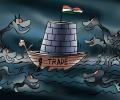
Indian exporters shipping goods to Israel may face higher insurance premiums and shipping costs due to the Israel-Hamas conflict, according to experts. Israel witnessed a surprise and unprecedented multifront attack by air, land and sea by the Hamas militant group, which rules the Gaza Strip, in its southern parts on Saturday morning. The International trade experts said the conflict may reduce the profits of domestic exporters but will not impact trade volumes unless war escalates.
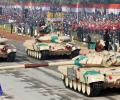
'Russia has got inherent military strength, they have a very good military equipment manufacturing infrastructure and by and large they are self-sufficient in their production capabilities'

'Hacking of an ID or an account will have the same impact on a user in a city and one in a small town.' 'Security is like a railroad, you create it to last for every customer.'

Mounting a fresh attack on the Congress, Prime Minister Narendra Modi on Friday alleged that for the sake of vote bank politics, it has nurtured, given shelter and surrendered before terror.

Domestic stock markets would be driven by inflation numbers, global trends, and the last batch of Q4 earnings this week, analysts said. Markets will also react to industrial production data and consumer inflation numbers that were released after market hours on Friday. "Participants will react to macroeconomic data viz. IIP and CPI first, which were released post-market hours on Friday.
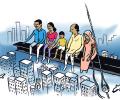
The affordable housing segment may be seeing an uptick which is a good sign of consumption momentum. This is the biggest-ticket purchase for middle income and lower income families. The current activity is at least partly driven by a pause in interest rate hikes.

India will require a total investment of $10.1 trillion to achieve net-zero emissions by 2070, while the nation could face a shortfall of $3.5 trillion, a study by CEEW Centre for Energy Finance (CEEW-CEF) said. At the recently concluded COP26, Prime Minister Narendra Modi announced India's aim to achieve net-zero emissions by 2070. "India would need cumulative investments of $10.1 trillion to achieve net-zero emissions by 2070, according to an independent study released today by the CEEW Centre for Energy Finance (CEEW-CEF)," a statement said.
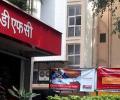
The impending merger between Housing Development Finance Corporation (HDFC) with HDFC Bank may create challenges for large-cap fund managers, most of whom are already grappling to match the returns generated by their benchmarks. The combined weight following the merger in the benchmark Sensex and Nifty 50 indices is likely to be much higher than permissible limits for active mutual fund (MF) schemes. This could have a bearing on the performance of large-cap funds if HDFC Bank shares outperform the markets, as the schemes will be forced to remain underweight on the stock to adhere to the single-stock cap.
.jpg)
The World Bank in its report said the relative importance of remittances as a source of external resources is expected to increase further.

Discussion paper fixes Rs 1,000 cr as minimum capital for these specialised banks

After agonizing over this for weeks, he made a decision. When they met after work one evening, he startled her by blurting out, 'I think we should break up.' A moving excerpt from Chitra Banerjee Divakaruni's An Uncommon Love: The Early Life of Sudha and Narayana Murthy.

Experts say the recent Rs 14,000-crore PNB fraud could have been avoided had there been an integration of PNB's CBS with its SWIFT system

The Securities and Exchange Board of India (Sebi) is in the process of issuing a standard operating procedure (SOP) for designated depository participants (DDPs) regarding disclosures and onboarding of foreign portfolio investors (FPIs), according to a regulatory document seen by Business Standard. DDPs act as a link between the markets regulator and overseas investors. The SOP, framed in consultation with the industry, aims to bring consistency across all players and avoid any form of regulatory arbitrage.
The RBI on Tuesday maintained status quo on interest rates, saying there have been no developments to warrant further easing since an unscheduled rate cut about a fortnight ago.

'Although mid- and small-cap funds have the potential for higher growth, they come with inherent higher volatility.'
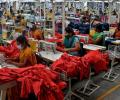
Enthused by higher than expected GDP numbers in the fourth quarter of 2022-23, Chief Economic Adviser (CEA) V Anantha Nageswaran on Wednesday said India's economic growth may exceed the initial estimate of 6.5 per cent in the current fiscal and the country can look for another year of solid economic performance.
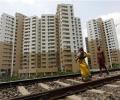
Slump in realty market to add to woes, debt of top players likely to rise 15-20% this financial year
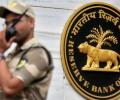
A day after the RBI raised the benchmark lending rate by 35 basis points, Kotak Mahindra Bank Managing Director Uday Kotak on Thursday said the central bank may go for one more rate hike to bring inflation below its upper tolerance level of 6 per cent. Yesterday, the RBI indicated that it wants inflation to be within the band first and then move towards the target of 4 per cent, Kotak said at the CII Global Economic Policy Summit 2022. "My sense is that there could be one more rate hike and that may be the time for thinking about a pivot, but we got to watch very closely the data, and maybe around 6.5 per cent as it looks today, subject to what happens to the world, subject to what happens to oil, subject to what happens to many other things," he said.

For all its claims to economic glory, the majority of India's population lives vulnerable lives, a situation that has only worsened over the past 15 years, to the extent that the government now fears to release economic data or even conduct a proper Census, notes Rathin Roy.

Prime Minister Narendra Modi on Tuesday asserted that there is a "huge difference" between pre- and post-2014 India, saying the country is now moving ahead at an "unprecedented speed and scale" as he showcased the achievements of his term in power to the Indian diaspora in Indonesia.

Stocks of small- and mid-cap companies continued to gain ground in July, notwithstanding analysts sounding caution on these two market segments given the sharp run thus far in calendar year 2023 (CY23). Sanjeev Prasad, co-head of Kotak Institutional Equities, in a note co-authored with Anindya Bhowmik and Sunita Baldawa in June-end, had cautioned against the sharp run in small- and mid-caps. "We do not see any particular reason for the excitement in small- and mid-cap stocks.

The foremost lesson is that technology has got commoditised.

Make sure that the person you are buying the plot from is the rightful owner.

'We are all in a tizzy about NBFCs in the aftermath of the IL&FS default.' 'We tend to jump to the notion that an NBFC is like a bank. But banks make a promise that deposits are liquid and have an assured return.' 'NBFCs make no such promises,' points out Ajay Shah.

'Initially, Gift City was just another real estate project, but all that changed with Modi moving to New Delhi,' notes Tamal Bandyopadhyay.

While the market for satellite broadband currently is small, the potential is large as an estimated 30 per cent of the country does not have reliable terrestrial broadband services.

'With nearly double the market share of our nearest competitor, we are shaping the digital transformation journey of close to 1,000 clients in India.'
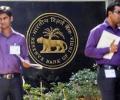
The decision to increase the quantum of capital infusion was taken at a meeting between Finance Minister P Chidambaram, RBI Governor Raghuram Rajan and Economic Affairs Secretary Arvind Mayaram in New Delhi.

From the enactment of the capital control Act to the recognition of the BSE as a stock exchange and the infamous Harshad Mehta scam, here are the 18 biggest events for stock markets from 1947 to 1993.
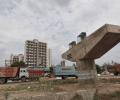
If 4,000 workers could work round the clock for the construction of the new Parliament building, then there is no reason why all infrastructure projects too cannot follow that model, asserts Dr Sudhir Bisht.
An early action to allow domestic banks to participate in the commodity markets would not only help in improving their competency but would also help in develop their trading and product development skills in commodity derivatives.

The Uttar Pradesh Defence corridor is estimated to attract Rs 20,000 crore investment and create 250,000 jobs.
 © 2026 Rediff.com - Advertise with us - Disclaimer - Privacy Policy - Sitemap - Feedback - About us - Terms of use - Grievances